The history of skiing in Morzine dates back to the 1920s, when two local pioneers helped set the village on the path towards becoming the ski resort we know today. But Morzine’s story began long before skiing, shaped by centuries of farming, slate mining and the development of tourism in this once-isolated Alpine valley.
In 1181 Morzine, then called Morgenes meaning border area in Latin, was recorded as the ‘granges’ of Aulps Abbey, the Cistercian monastery located down the road in St Jean d’Aulps. The granges were agricultural areas where the monks worked the land and farmed livestock to provide the church community with food, clothing and building materials. The granges were key to the survival and growth of the Cistercian’s. In 1531 St Jean d’Aulps gained independence from the Cistercians and the village thrived as a small, peaceful farming community. Later, in the 18th century, Morzine’s main economic activity became slate mining and many mines in the valley were exploited, a few of which can still be seen today.
A Ski Resort Is Born
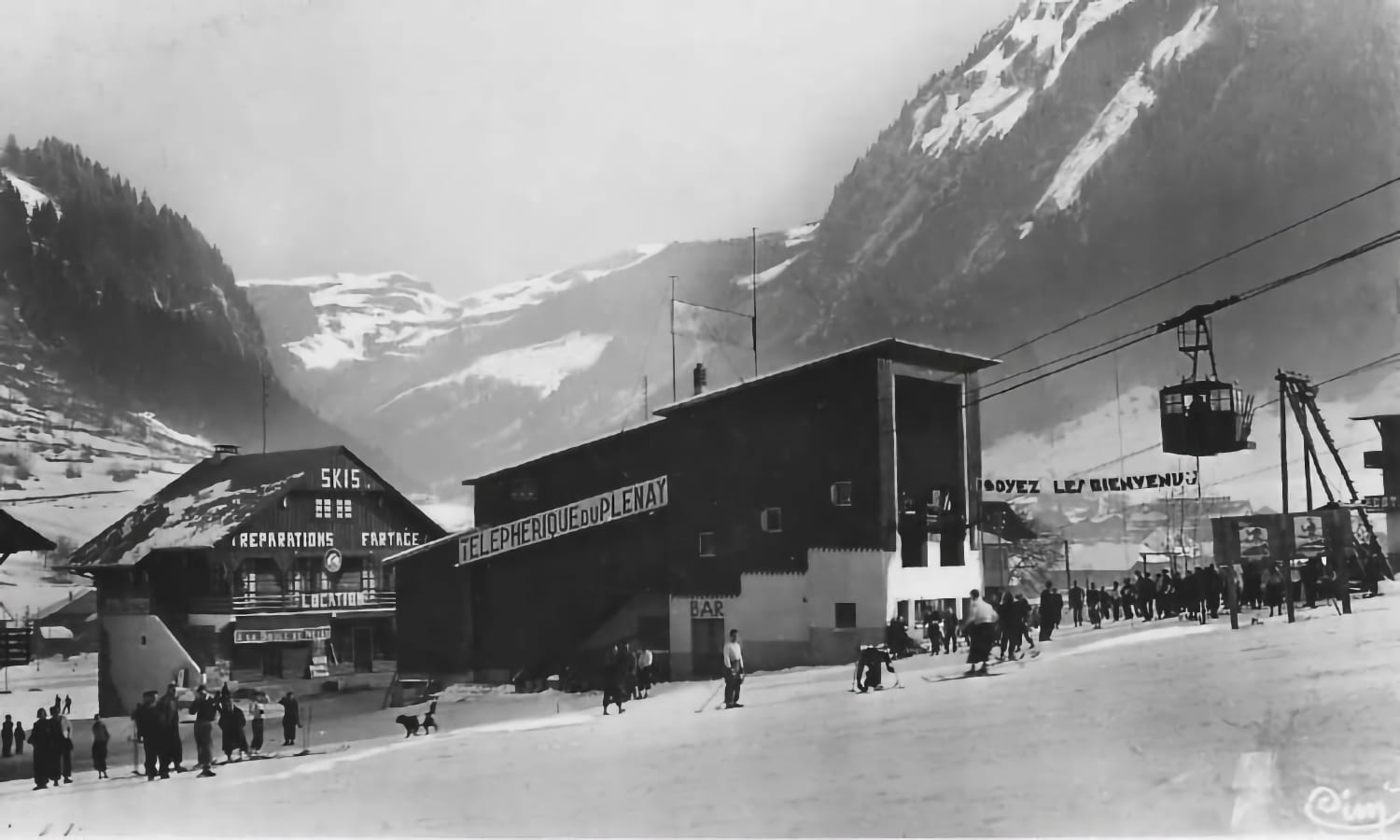
The slate mining brought wealth to the area and eventually tourism followed. The catalyst for this new industry was local businessman Francois Baud building the Grand Hotel in 1925. It was the first hotel to be built in Morzine and he ingeniously located it at the foot of the Pleney mountain. He then went on to develop ski runs on the slopes of the Pleney directly behind the hotel. The first incarnation of the Pleney lift was installed in 1934 and was just the second ever lift to be built in the whole of France. At first the lift was mostly used by hikers but it soon tempted the more daring skiers looking for more of a challenge and voila…. Morzine became a ski resort.
The name Francois Baud will forever be synonymous with Morzine and his descendants still live in the town. The Super Morzine suspension bridge also carries his name.
Morzine During The War
Unfortunately the second world war then brought a halt to the development of skiing in the area. The Nazis occupied the town and ran regular patrols as the Col du Cou at the end of Vallee de la Manche borders Switzerland and became a vital smuggling route. Resistance fighters used the Col to smuggle weapons and fighters into France and Jews used it as a gateway to freedom from Nazi oppression.
Olympic Gold Drives Things Forward
Back in peacetime it wasn’t long before Morzine was back at the forefront of the ski world. Local skier Jean Vuarnet won Gold in the downhill at the 1960 Squaw Valley Olympics in California and the town rallied behind him upon his return. Vuarnet was the driving force behind the development of the ski area and he was instrumental in the creation of Avoriaz and the linking up of local resorts forming what we now know as the Portes du Soleil.
Today Morzine is the heart of the Portes du Soleil and is the main resort town with a vibrant community and year round tourism. The ski area surrounding the town is amongst the largest in the world attracting millions of tourists every year. With over 650km of piste, 316 slopes accessed by 197 lifts which span 12 resort towns across two countries, I wonder if Francois Baud was aware of what he was starting back then in 1925??
From Medieval Farming Community to Mountain Village
Today, Morzine is one of the best-loved ski resorts in the French Alps. Sitting at the heart of the vast Portes du Soleil ski area, it welcomes visitors from around the world with its traditional Savoyard charm, lively atmosphere and access to more than 600km of skiing. But Morzine wasn’t always a bustling mountain resort. Long before ski lifts, chalets and après-ski bars, it was a quiet farming community where life revolved around the seasons. The story of how it became one of Europe’s premier ski destinations is a fascinating journey spanning more than 800 years.
From Medieval Farming Community to Mountain Village
The earliest known record of Morzine dates back to 1181, when it was known as Morgenes, meaning “border area” in Latin. At the time, the village formed part of the lands owned by the nearby Cistercian Abbey of Aulps in Saint-Jean-d’Aulps. The monks relied on surrounding agricultural settlements, known as granges, to grow crops, raise livestock and produce the supplies needed to sustain the abbey. For centuries, farming shaped everyday life in the valley and the peaceful mountain landscape we admire today owes much to generations who worked the land long before tourism arrived. When Saint-Jean-d’Aulps gained independence from the Cistercian Order during the 16th century, Morzine gradually developed into a thriving alpine village with farming remaining its principal way of life.
Slate Mining Brings Prosperity
By the 18th and 19th centuries, Morzine had discovered another valuable resource hidden within its mountains. Slate mining became the valley’s primary industry, providing employment for local families and bringing increasing prosperity to the region. Roofs across Haute-Savoie were covered using Morzine slate and although the mines have long since closed, traces of this important industry can still be found around the valley today. The wealth generated through mining helped lay the foundations for the next chapter in Morzine’s history.
The Vision That Changed Everything
The true story of skiing in Morzine begins with one remarkable local businessman: François Baud.
Recognising the area’s potential for tourism, Baud opened the Grand Hôtel in 1925, the very first hotel in Morzine. Rather than simply offering visitors somewhere to stay, he had a much bigger vision. The hotel was strategically built at the foot of Le Pléney, the mountain that now overlooks the centre of the village. Baud understood that the surrounding slopes could become a playground for winter sports and began developing ski runs directly behind the hotel. His vision proved revolutionary.
In 1934, the first Pléney ski lift was installed. It was only the second ski lift ever built in France, marking a turning point not only for Morzine but for French skiing as a whole. Initially, the lift attracted walkers wanting to enjoy the mountain views, but adventurous skiers soon realised the potential of the terrain. Before long, Morzine had established itself as an emerging ski destination. Today, François Baud is still regarded as one of the founding fathers of modern Morzine and his legacy lives on throughout the resort. The suspension bridge linking the centre of the village to Super Morzine proudly bears his name, and his family continues to have close ties with the town.
Morzine During the Second World War
Like much of Europe, Morzine’s development came to an abrupt halt during the Second World War. The village was occupied by German forces, while the nearby Col du Cou, bordering Switzerland, became an important route for the French Resistance. Under the cover of darkness, resistance fighters crossed the mountains carrying weapons, intelligence and supplies, while many Jewish families used the same route in desperate attempts to escape Nazi persecution. Today, it’s hard to imagine these peaceful mountain passes once played such a significant role in wartime history.
Olympic Success Sparks a New Era
Following the war, skiing returned to Morzine with renewed enthusiasm. The next major chapter arrived in 1960, when local skier Jean Vuarnet won Olympic gold in the downhill event at the Winter Olympics in Squaw Valley, California. His victory placed Morzine firmly on the international skiing map and inspired huge investment across the valley. Vuarnet became one of the driving forces behind the creation of Avoriaz, one of the Alps’ most innovative purpose-built ski resorts. More importantly, he played a key role in linking together the surrounding ski areas to create what is now known as the Portes du Soleil. This ambitious collaboration transformed the region into one of the largest linked ski areas in the world.
Morzine Today
Nearly a century after François Baud welcomed his first guests to the Grand Hôtel, Morzine has developed into a thriving year-round mountain destination. The resort perfectly balances tradition and modernity. Horse-drawn sleighs still pass through the village during winter, traditional wooden chalets line the streets and family-run businesses continue to give Morzine its welcoming atmosphere. At the same time, visitors enjoy access to an enormous international ski area spanning France and Switzerland, with more than 600km of pistes, around 200 ski lifts and 12 interconnected resorts.
Whether you’re taking your first ski holiday, travelling with family or returning year after year, it’s remarkable to think that this world-famous destination all began with one local entrepreneur who believed visitors would fall in love with his mountains.
Ready to experience Morzine for yourself?
Understanding Morzine’s history makes exploring the resort even more rewarding. Every ski lift, mountain restaurant and village street has played a part in its remarkable transformation from a quiet farming community into one of Europe’s premier ski destinations. If you’re thinking about discovering Morzine for yourself, I’d love to help you find the right chalet for you. Get in touch and let me help you create a holiday that you will absolutely love.